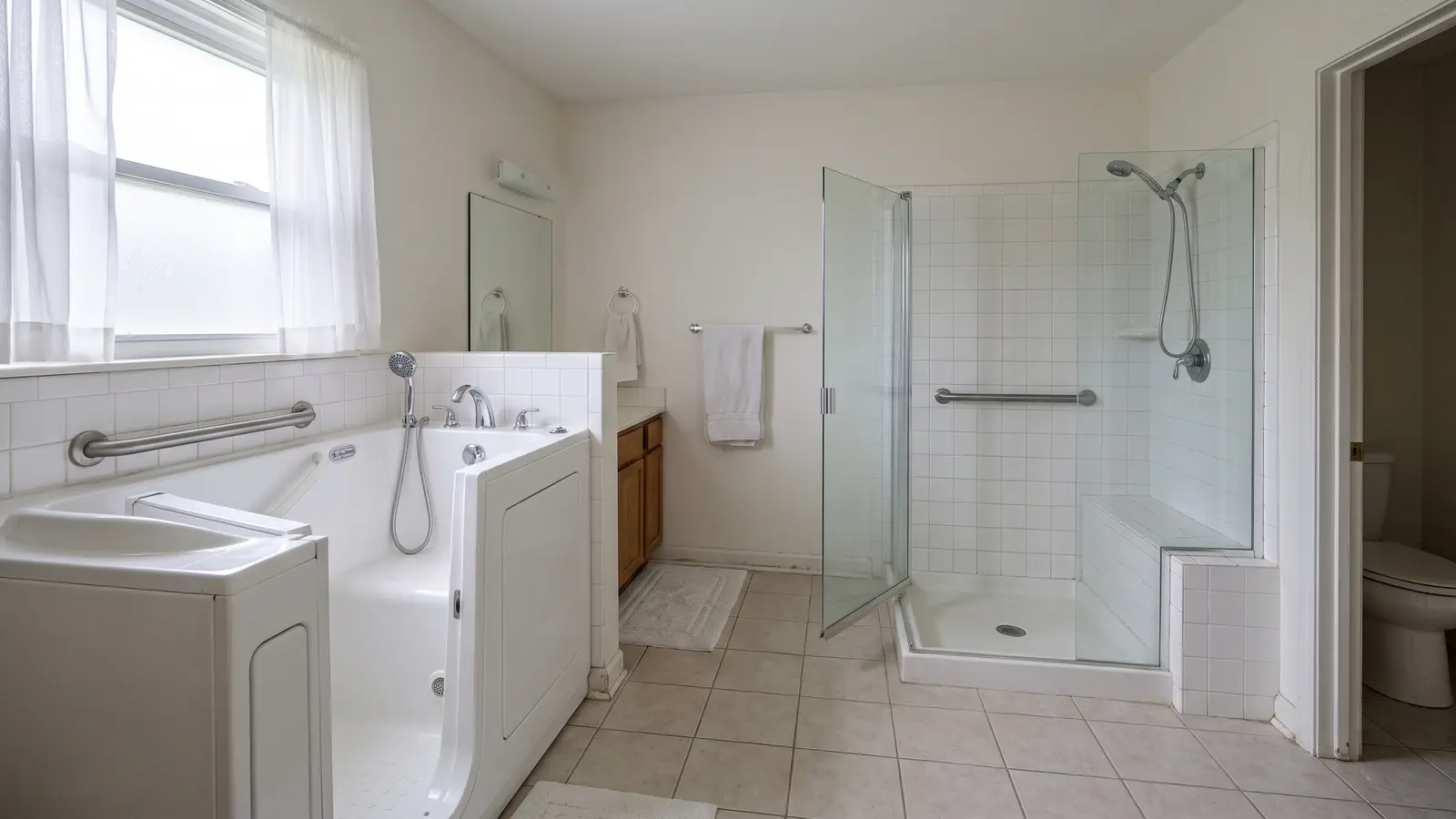
Walk-in tub vs. walk-in shower for staying in your Lexington home
Once climbing over a tub wall starts to feel risky, most families weigh two upgrades: a walk-in tub with a sealed door, or a shower with little or no curb. Both make bathing safer. They're very different to use every day, though, and the choice affects cost, water heating and how much help a caregiver can give. Here's how they stack up.
Get a Free Quote
Fast. Easy. No obligation.
Quick answer
In Lexington, a walk-in tub typically costs $9,000–$20,000 installed and a walk-in shower $8,000–$18,000. Either is usually a one- to two-week project. For most people aging in place, a low-entry shower with a seat and grab bars is quicker to use and easier to clean. A walk-in tub suits people who truly want to soak.
Option A
Walk-In Tub
A deep tub with a watertight door in the side and a molded seat. You step through the door, sit down, close it and fill the tub around you.
Option B
Walk-In Shower
A shower with a low threshold or a curbless entry, usually fitted with a fold-down or built-in seat, grab bars and a handheld shower on a slide bar.
| Walk-In Tub | Walk-In Shower | |
|---|---|---|
| Installed cost in Lexington | About $9,000–$20,000 | About $8,000–$18,000; full accessible remodels about $10,000–$30,000 |
| Entry | A short step through the door | A low curb or none; can be built for a wheelchair |
| Waiting time | You sit inside while it fills and while it drains | No wait; turn on the water and go |
| Soaking | Deep, seated soak; some models add jets | No soak |
| Hot water | May need a larger or faster water heater | Works with a typical water heater |
| Cleaning | Door gasket, seat and any jet lines | Walls, floor and glass; hard water spots on glass |
| Caregiver access | Hard to help someone sitting low in a deep tub | Room to stand beside the seat and assist |
| Good fit for | People who soak for comfort or sore joints | Most aging-in-place and mobility needs |
What are the disadvantages of a walk-in tub?
The main one is time. The door must be shut before the tub fills and can't open until the water drains, so every bath includes sitting in an empty or draining tub. On a cold Kentucky morning that can be uncomfortable. Fast-drain models shorten the wait but don't remove it.
There are others. Deep tubs hold a lot of water, and some homes need a bigger or faster water heater to fill one with hot water, which adds to the cost. The door seal needs regular cleaning and checking. Getting down onto the seat and back up still takes some strength and balance. And for someone who uses a walker or wheelchair, a tub door is still a barrier. We check the water heater, floor framing and doorway width during every walk-in tub estimate so none of this is a surprise.
Which one is safer for limited mobility?
For most people, the shower. A curbless shower with a linear drain leaves nothing to step over at all, so it works with a shower chair, a walker or a wheelchair. Add a fold-down seat, grab bars placed where the person actually reaches, a handheld head on a slide bar and a slip-resistant floor, and many people can keep bathing on their own for a long time.
A walk-in tub removes the high tub wall, which is a real improvement. But it still asks you to step in, sit low and stand back up, often with wet hands. If balance is already an issue, or a caregiver helps with bathing, the open space of a shower is easier for everyone. Our accessible bathroom projects are planned around exactly these details.
Does the house itself make a difference?
It can. Many postwar ranches in Tates Creek, Southland and Gardenside have one full bath with a standard 60-inch tub. That alcove converts cleanly into a low-entry shower, and it can also hold some walk-in tub models. In older homes in Chevy Chase or Kenwick, narrow bathroom doors and plaster walls may limit what can be carried in, and old cast-iron drains may need replacing either way.
If the new fixture moves the drain, Kentucky requires a state plumbing permit from the Department of Housing, Buildings and Construction. We confirm the permit path and pull what's needed. See our permit guide for more.
How do the costs compare?
In the Lexington area, a walk-in tub usually runs $9,000–$20,000 installed, depending on the model, jets or heated surfaces, and any plumbing or water heater changes. A walk-in shower is typically $8,000–$18,000. A full accessible remodel with a curbless shower, a wider door and comfort-height fixtures is about $10,000–$30,000.
On a tighter budget, a tub-to-shower conversion with a low-threshold base, seat and grab bars costs about $6,000–$14,000 and covers most of the safety gains.
What about resale later on?
A well-built walk-in shower appeals to nearly every buyer. A walk-in tub appeals to a smaller group. If a sale is possible in the next few years, the shower is usually the safer bet, and keeping a regular tub in a second bathroom covers buyers with young kids.
The verdict
Choose a walk-in shower if the goal is safe, quick, independent bathing, if a walker or wheelchair is in the picture now or may be later, or if someone helps with bathing.
Choose a walk-in tub if a long, seated soak really matters to you, for comfort or pain relief, and you don't mind sitting in the tub while it fills and drains. Either way, schedule a free visit. We'll measure the space, check the water heater and give you a written, itemized quote for each option.
Related services
Questions people ask
Will Medicare pay for a walk-in tub?
Original Medicare generally doesn't cover walk-in tubs. Some Medicare Advantage plans, Medicaid waiver programs or VA programs may help, so check with your plan directly.
Are walk-in tubs worth it for seniors?
For someone who soaks often, they can be. For most people focused on safety, a low-entry shower with a seat and grab bars is simpler, faster and usually costs less.
Can a walk-in tub fit where my old tub is?
Many models are made for a standard 60-inch alcove. We measure the space, the doorway and the water heater before recommending one.
Can a walk-in shower work with a wheelchair?
Yes. A curbless, roll-in shower with a linear drain, a fold-down seat and grab bars is built for it. See accessible bathrooms.
Do walk-in tubs leak?
The door gasket is the part to watch. A tub set level and maintained as the manufacturer directs should seal well, but the gasket needs regular cleaning and checks.
Ready for a Bathroom That Works?
A leaky, dated or hard-to-use bathroom doesn't get cheaper to fix. Get a free written quote and a plan you can hold us to.
- Calls answered 24/7
- Free, written estimates
- Lexington & nearby